
Siddhi cooks with mango two ways. Raw mango is cooked first, for aam panna and raw mango curry. Ripe mango is pureed or blended for lassi, shakes, shrikhand, custard, pudding and mousse. This guide shows which recipe uses which, and how she prepares each.
Every recipe linked in this guide is cooked in Siddhi’s own kitchen before it goes live.
The short answer
Raw mango is cooked; ripe mango is pureed or blended.
- Raw mango: peel, chop and cook in boiling water until the pieces turn transparent.
- Ripe mango: peel, chop and grind with the sugar into a puree, or blend with milk or ice cream.
- Thick mango puree: used straight in shrikhand, custard and pudding.
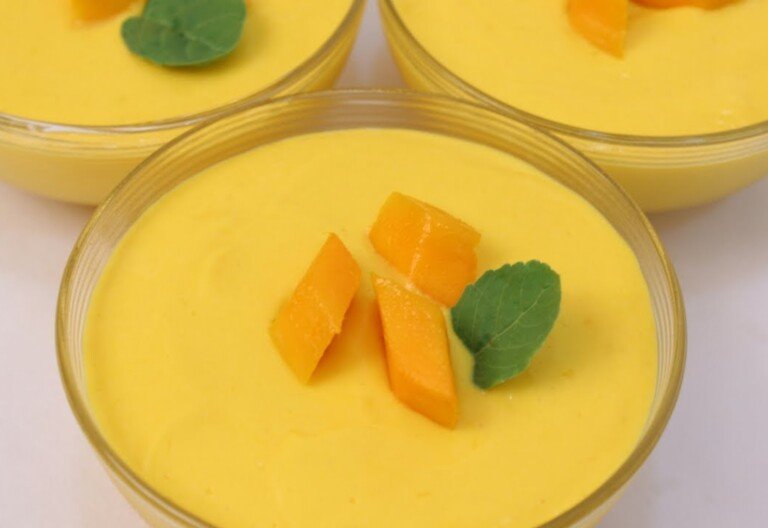
Which mango for which recipe
| Recipe | Mango | How it is used |
|---|---|---|
| Aam Panna | 500 g raw mango, peeled and chopped | Cooked, then ground and strained |
| Raw Mango Curry | 1 raw mango, peeled and finely chopped | Boiled, then added to a tadka |
| Mango Lassi | 1 ripe mango, peeled and chopped | Ground with sugar to a puree |
| Mango Thickshake | 1 ripe mango, roughly chopped | Ground with milk and ice cream |
| Mango Mousse | 3 ripe Alphonso mangoes | Pureed with sugar, no water |
| Pulpy Mango Milkshake | 1 cup mango pieces and 1 cup small pieces | Blended lightly so it stays pulpy |
| Mango Chocolate Smoothie | 1 cup mango pieces | Blended to a puree, then with ice cream |
| Mango Shrikhand | ½ cup thick mango puree | Mixed into hung curd |
| Mango Custard | 1 cup thick mango puree and ½ cup chopped mango | Mixed into the custard |
| Mango Pudding | 1 cup thick mango puree | Mixed with corn flour and milk |
| Mango Iced Tea | ½ cup mango puree and ¼ cup chopped mango | Whisked into the tea |
Cooking raw mango
Both of Siddhi’s raw mango recipes cook the mango in water until it turns transparent.
- Aam Panna: she heats 2 glasses of water, adds the chopped raw mango and black peppercorns, and cooks on full flame with the lid on, leaving a little opening, for 8 to 10 minutes. Once the pieces turn transparent, she lets them cool, grinds the pulp with sugar, black salt and salt, and strains it with the saved cooking water.
- Raw Mango Curry: she washes, peels and cubes the mango, boils it in 1 glass of water on a high flame, then cooks it for another 10 to 15 minutes on a low flame. After 10 minutes she checks: the cubes turn a little transparent when they are cooked. If not, she cooks them for another 2 to 5 minutes.
Pureeing and blending ripe mango
- For Mango Mousse and Mango Lassi, Siddhi grinds the chopped mango with the sugar into a puree. For the mousse she adds no water.
- For Mango Thickshake, she grinds the mango with cardamom powder, sugar, ice cream and 1 cup (250 ml) of milk until all the pieces turn smooth.
- For Pulpy Mango Milkshake, she blends lightly, twice, so it turns pulpy. She says not to blend too much, as that makes the milkshake thick.
- For Mango Chocolate Smoothie, she blends the mango to a puree first, then adds the ice cream and blends until smooth.
Recipes that use thick mango puree
Three of Siddhi’s desserts call for thick mango puree: Mango Shrikhand (½ cup, mixed with hung curd, cardamom and saffron water), Mango Custard (1 cup, plus ½ cup chopped mango) and Mango Pudding (1 cup, mixed with corn flour and milk). Her Mango Iced Tea uses ½ cup mango puree.
FAQs
Which of Siddhi’s recipes use raw mango?
Her Aam Panna and Raw Mango Curry use raw mango. Both cook the mango in boiling water until the pieces turn transparent.
How do I know when raw mango is cooked?
In Siddhi’s Aam Panna and Raw Mango Curry, the raw mango pieces turn transparent when they are cooked.
Do I add water when making mango puree?
For her Mango Mousse, Siddhi purees the chopped mango with the sugar and says not to add water.
Which mango does Siddhi use for mousse?
Her Mango Mousse uses 3 ripe Alphonso mangoes, peeled and chopped into small pieces.
Why is my mango milkshake too thick?
For her Pulpy Mango Milkshake, Siddhi blends lightly, twice, and says blending too much will make the milkshake thick.
More cooking guides
- How to Make the Perfect Tadka
- How to Cook Dal and Khichdi in a Pressure Cooker
- How to Thicken Milk for Kheer and Kulfi
- Cooking With Jaggery: Chikki, Ladoo and Sukhdi
- How to Fry Pakoda, Vada and Cutlets
- Rice for Pulao, Fried Rice and Flavoured Rice
- The Spices in Siddhi’s Kitchen
- Indian Kitchen Measures: Cup, Spoon, Katori and Grams
- How to Make Hung Curd at Home
- Kitchen Fixes: Too Salty, Too Watery, Too Thick
- How to Bind, Shape and Coat Cutlets and Kebabs
- What to Soak and for How Long
- How to Knead and Shape Dough for Gujiya, Spring Rolls and Gatta
- Saffron and Cardamom in Indian Sweets and Drinks