
Do you really need a food processor if you already own a mixer grinder? Or can a mixer grinder do everything? These two appliances look like they overlap, but in an Indian kitchen they solve very different problems. One grinds; the other chops, slices and kneads.
This guide compares a mixer grinder vs food processor for everyday Indian cooking, task by task, so you can decide whether one is enough, which one to buy first, and when it’s worth owning both.
The short answer: mixer grinder or food processor?
Buy a mixer grinder first if you cook Indian food regularly: it grinds masala pastes, chutneys, batters and spice powders, which a food processor can’t do well. Add a food processor if you spend a lot of time chopping, grating, slicing or kneading dough.
- Mixer grinder: high-speed grinding in small jars. Essential for Indian cooking.
- Food processor: slower, bigger bowl with blades and discs for prep work and dough.
- Combo food processors: many models sold in India include grinder jars too, which suits big families with space.
What’s the difference between a mixer grinder and a food processor?
A mixer grinder is built for speed. Its motor, often 500 to 1,000 W, spins small stainless-steel jars at very high speed so that spices, soaked dals, coconut and tomatoes turn into fine pastes, batters and powders. Most come with three or four jars: a large blender jar, a medium wet-grinding jar and a small dry or chutney jar.
A food processor is built for volume and variety. It has a wide bowl, usually 1.5 to 3 litres, and a set of attachments: an S-shaped chopping blade, slicing and grating discs, a dough-kneading blade and often a citrus juicer. It runs slower, which gives you control over texture, so onions come out chopped rather than puréed.
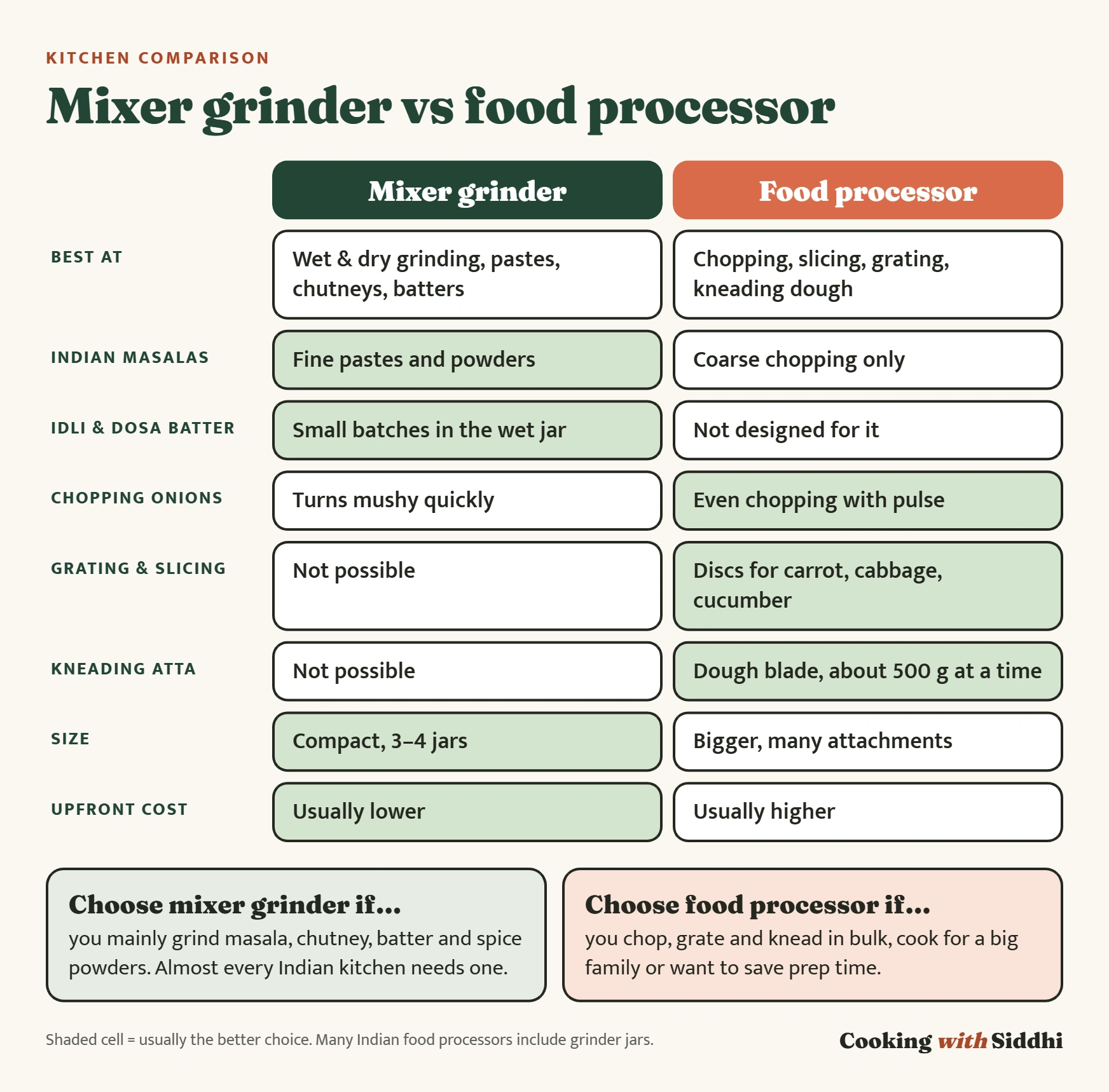
Side-by-side comparison
| Feature | Mixer grinder | Food processor |
|---|---|---|
| Main job | Grinding and blending | Chopping, slicing, grating, kneading |
| Typical power | About 500 to 1,000 W | About 600 to 1,000 W |
| Containers | 3 to 4 jars, from about 0.3 to 1.5 litres | One large bowl, about 1.5 to 3 litres |
| Speed | Very high; best for fine textures | Lower and controlled; best for even cuts |
| Masala pastes and chutneys | Excellent | Coarse at best |
| Dry spice powders | Excellent in the small jar | Poor |
| Batter for idli and dosa | Good for small batches | Not suitable |
| Chopping and grating | Poor; tends to purée | Excellent |
| Kneading dough | Not possible | Yes, in batches |
| Cleaning | Quick; rinse jars and blades | More parts to wash |
Which is better for everyday Indian tasks?
Ginger-garlic paste, green chutney and masala pastes
Winner: mixer grinder. Its small jars and high speed make smooth pastes from small quantities. A food processor’s wide bowl leaves bits stuck to the sides and rarely gets truly fine.
Dry spice powders like garam masala and sambar powder
Winner: mixer grinder. The dry jar turns roasted whole spices into fine powder in under a minute. Food processors aren’t designed for dry grinding.
Idli, dosa and dhokla batter
Winner: mixer grinder for small families. Its wet jar handles soaked rice and urad dal well in small batches. If you make batter several times a week for a big family, a wet grinder gives fluffier results; see our wet grinder vs mixer grinder comparison.
Chopping onions, tomatoes and vegetables
Winner: food processor. A few pulses give evenly chopped onions for a big batch of pav bhaji or biryani without turning them into paste. A mixer grinder chops unevenly and quickly overprocesses.
Grating carrots, cabbage, cucumber and paneer
Winner: food processor. Grating discs make quick work of gajar halwa, koshimbir and cabbage sabzi. A mixer grinder can’t grate.
Kneading atta for rotis
Winner: food processor. The dough blade kneads roughly 300 to 500 g of atta at a time in a couple of minutes, which is a real time-saver for large families. Check the model’s maximum kneading capacity before buying.
Smoothies, lassi and milkshakes
Winner: mixer grinder. The large blender jar handles drinks easily. Many food processors include a blender jar too, but it’s often smaller.
A typical Indian week: which appliance does what?
Still not sure how much you’d use a food processor? Picture an ordinary week in a family of four:
- Monday: green chutney and ginger-garlic paste for the week (mixer grinder).
- Tuesday: dal tadka and jeera rice; a quick tomato purée for the dal (mixer grinder).
- Wednesday: idli batter soaked in the morning and ground in the evening (mixer grinder or wet grinder).
- Thursday: grated cabbage and carrot for a koshimbir and a big bowl of chopped salad (food processor).
- Friday: pav bhaji for six, with a mountain of onions, capsicum and tomatoes to chop (food processor).
- Weekend: two days of roti dough kneaded in minutes (food processor) and a fresh batch of garam masala (mixer grinder).
If most of your week looks like Monday to Wednesday, a mixer grinder covers you. If Thursday to the weekend sounds familiar, a food processor will quickly earn its place.
Is it worth owning both?
For many Indian homes, yes. Think of the mixer grinder as your everyday essential and the food processor as a prep assistant. If you cook for four or more people, make dough daily or batch-prep vegetables on weekends, a food processor can save 20 to 30 minutes on a busy day. If you cook for one or two and rarely chop in bulk, a good mixer grinder and a sharp knife are enough.
Short on space? Look at a food processor that comes with mixer grinder jars. They’re bulkier and cost more, but one motor base does both jobs.
What to look for when buying
In a mixer grinder
- Wattage: 750 W is a good all-rounder for Indian grinding; go higher if you grind hard spices or batter often.
- Jars: a blender jar, a wet jar and a small dry jar cover most needs; a fourth jar helps big families.
- Overload protection and a sturdy base with suction feet.
- Warranty and service: motors get heavy use, so local service matters.
In a food processor
- Bowl size: about 2 litres or more for a family of four.
- Attachments you’ll actually use: chopping blade, slicing and grating discs, and a dough blade.
- Kneading capacity stated in grams of flour.
- Easy-clean design and space to store the attachments.
Care and safety tips
- Always lock the lid before switching on, and hold the jar or lid while the motor runs.
- Let hot food cool before blending; steam builds pressure and can push the lid open.
- Wash blades carefully. Use a brush rather than your fingers, and dry jars fully to prevent rust spots and smells.
- Check the coupler (the rubber or plastic piece that connects jar to motor) and replace it when it wears out.
- Give the motor a break between batches, especially when grinding batter or hard spices.
Common mistakes to avoid
- Running a mixer grinder too long. Grind in short bursts and let the motor rest; most manuals recommend short cycles to avoid overheating.
- Overfilling jars. Fill wet jars to about half or two-thirds for smooth results.
- Using a food processor for masala paste. It’s not built for fine grinding; use the mixer.
- Buying a food processor you have no space for. If it lives in a cupboard, you won’t use it.
Frequently asked questions
Can a food processor replace a mixer grinder?
Not for most Indian cooking. A food processor can’t grind masala pastes, chutneys, batters or dry spice powders finely. Some food processors come with grinder jars, which can replace a separate mixer grinder.
Can a mixer grinder chop vegetables?
It can roughly chop small amounts using short pulses, but it tends to purée them. For even chopping, slicing or grating, a food processor works much better.
Can I knead dough in a mixer grinder?
No. Mixer grinders aren’t designed to knead dough. A food processor with a dough blade or a stand mixer is needed for kneading atta.
What wattage mixer grinder is best for Indian cooking?
A 750 W mixer grinder handles most Indian grinding well, including masala pastes and small batches of batter. Choose 1,000 W if you grind hard spices or large quantities often.
Is a food processor worth buying in India?
It’s worth it if you cook for a large family, knead dough daily or chop and grate in bulk. For small households that cook simply, a mixer grinder and a good knife are usually enough.
Which should I buy first?
Buy a mixer grinder first. It handles the grinding that almost every Indian dish depends on. Add a food processor later if prep work takes up too much of your time.
The bottom line
A mixer grinder is the heart of an Indian kitchen; it’s the one you’ll use every single day. A food processor is a helpful extra for families who chop, grate and knead in bulk. Start with a good mixer grinder, and add a processor when prep time becomes the bottleneck.