
Walk into any Indian kitchen and you’ll usually find both: a shiny steel kadai for sabzi and a black nonstick tawa for dosas. But if you’re buying new cookware, which should you invest in? Is nonstick safe? Is stainless steel hard to cook with? And which one actually suits the way Indian food is cooked?
This guide compares stainless steel vs nonstick cookware for Indian cooking: how each handles tadka, bhuna masala and dosas, what to know about safety, how long they last, and the simple techniques that stop food sticking to steel.
The short answer: stainless steel or nonstick?
Choose stainless steel for high-heat cooking like tadka, bhuna masala, boiling and frying, and for cookware that lasts decades. Choose nonstick for low-oil, delicate cooking like chillas, dosas, uttapam and paneer. Most Indian kitchens do best with a mix of both.
- Stainless steel: durable, safe at high heat, non-reactive, works with any spatula.
- Nonstick: easy release, little oil, quick to clean, but limited to low and medium heat and wears out.
- Best combination: a steel kadai and saucepan, plus one nonstick pan or tawa for delicate jobs.
What’s the difference?
Stainless steel cookware is made from an iron alloy with chromium (and often nickel) that resists rust. On its own, steel heats unevenly, so good pans are clad or tri-ply: a layer of aluminium sandwiched between steel, either just in the base or all the way up the sides. That core spreads heat evenly, while the steel surface stays tough and non-reactive.
Nonstick cookware is usually aluminium coated with a slippery layer, most often PTFE (the material many people know as Teflon), or a ceramic-type coating. The coating stops food from sticking, so you need very little oil. The catch is that the coating is softer than steel and gradually wears away.
Side-by-side comparison
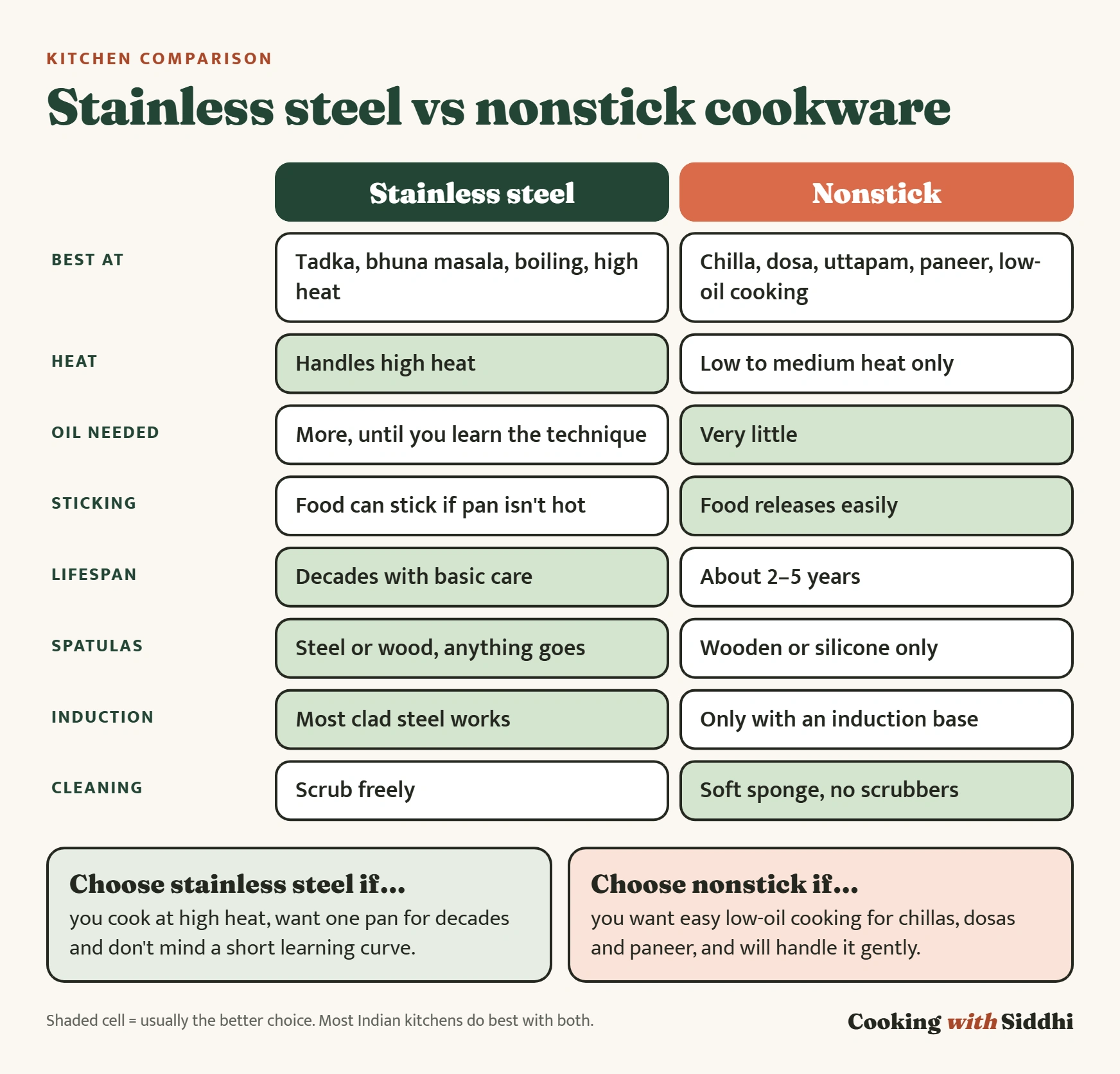
| Feature | Stainless steel | Nonstick |
|---|---|---|
| Heat tolerance | High heat is fine | Best kept at low to medium heat |
| Oil needed | More, especially when learning | Very little |
| Food release | Sticks if the pan isn’t hot enough | Releases easily |
| Browning and bhuna | Excellent; develops fond and deep flavour | Weaker browning |
| Lifespan | Decades with basic care | Typically about 2 to 5 years, depending on use |
| Utensils | Steel, wood or silicone | Wood or silicone only |
| Cleaning | Can be scrubbed; may need soaking | Wipes clean; no harsh scrubbers |
| Induction | Most clad steel with a magnetic base works | Only models with an induction-ready base |
| Acidic foods | Non-reactive; fine for tomato, tamarind, kokum | Fine while the coating is intact |
Which is better for Indian dishes?
Tadka and tempering
Winner: stainless steel. A proper tadka needs hot fat so mustard seeds pop and cumin sizzles. Steel handles that heat safely. Heating a nonstick pan hard with only a spoon of oil isn’t recommended. If you’re new to tempering, our guide on how to make the perfect tadka explains the order and timing.
Bhuna masala, sabzi and curries
Winner: stainless steel. Onion-tomato masala that’s cooked until the oil separates benefits from steel’s high heat and browning. The brown bits that stick to the bottom add flavour when you deglaze with a splash of water.
Dosa, uttapam, chilla and paratha
Winner: nonstick (or a seasoned cast iron tawa). Thin batters release cleanly from nonstick with very little oil, which makes it the easiest choice for beginners. Steel isn’t designed for this job.
Paneer, tofu and delicate vegetables
Winner: nonstick. Paneer cubes and soft vegetables like bhindi turn golden without breaking or sticking.
Boiling, dal, chai and rice
Winner: stainless steel. It’s ideal for anything with liquid: dal, rice, chai, milk and soups. It doesn’t stain, absorb smells or react with lemon and tamarind.
Deep frying
Winner: stainless steel or iron. A heavy steel or iron kadai is the safer, longer-lasting choice for puris, pakoras and samosas. Most nonstick makers don’t recommend deep frying.
Is nonstick cookware safe?
Used properly, modern nonstick cookware is generally considered safe for everyday cooking. A few sensible habits matter:
- Don’t overheat it. PTFE coatings can start to break down at very high temperatures (roughly above 260°C). Never heat an empty nonstick pan on high flame, and keep it to low or medium heat.
- Look for PFOA-free. PFOA was a chemical once used in making some coatings; most reputable brands now state that their pans are PFOA-free.
- Replace damaged pans. If the coating is badly scratched, flaking or peeling, it’s time for a new pan.
- Ventilate. Use your exhaust or chimney, especially when cooking at higher heat.
Stainless steel has none of these limits, which is why many families choose it for everyday high-heat cooking and keep nonstick only for delicate jobs.
How to stop food sticking to stainless steel
Most people who give up on steel never learned this simple technique:
- Heat the empty pan on medium for a minute or two.
- Test it: sprinkle a few drops of water. If they roll around like little balls, the pan is ready.
- Add oil, let it heat for a few seconds, then add your food.
- Don’t move food too early. Paneer or vegetables release naturally once they’ve browned.
- Deglaze any stuck bits with a little water; they add flavour to your gravy.
Care tips that make each last longer
Stainless steel
- Soak stuck-on food in warm water, then scrub. A paste of baking soda removes stubborn stains.
- Dry pans fully to avoid water spots.
- Rainbow-coloured heat tint is harmless; a little vinegar wipes it away.
Nonstick
- Use wooden or silicone spatulas only.
- Let the pan cool before washing; sudden temperature changes can warp it.
- Wash with a soft sponge and mild soap; avoid steel wool.
- Store with a cloth between stacked pans to protect the coating.
What should an Indian kitchen buy?
- Starter set for a small family: a steel kadai, a steel saucepan or patila, and one nonstick tawa or frying pan.
- Family of four or more: add a larger steel kadai for deep frying and a steel pressure cooker or cook-and-serve pot.
- Health-conscious, low-oil cooking: a good nonstick or a seasoned cast iron pan for chillas and dosas.
- Induction stove: check that every piece says induction compatible; tri-ply steel usually is.
Thinking about tawas specifically? Read our cast iron vs nonstick tawa comparison.
Frequently asked questions
Is stainless steel or nonstick better for Indian cooking?
For most Indian cooking, stainless steel is better because it handles high heat for tadka, bhuna masala and frying, and lasts for decades. Nonstick is better for low-oil, delicate cooking like chillas, dosas and paneer. Many kitchens use both.
Is nonstick cookware safe for daily use?
Generally yes, if you use it on low to medium heat, never heat it empty on high flame, use wooden or silicone spatulas and replace it when the coating is scratched or peeling. Choose PFOA-free cookware from a reputable brand.
Why does food stick to my stainless steel pan?
Usually because the pan wasn’t hot enough before adding oil and food, or because the food was moved too soon. Preheat the pan until water droplets roll around, add oil, then add food and let it brown before stirring.
How long does nonstick cookware last?
With careful use, a nonstick pan typically lasts about two to five years. High heat, metal utensils and harsh scrubbers shorten its life.
Can I make dosa on a stainless steel tawa?
It’s difficult, because thin batter sticks to steel easily. A nonstick or well-seasoned cast iron tawa works much better for dosa.
Is tri-ply stainless steel worth it?
Yes, if you cook often. Tri-ply has an aluminium core that spreads heat evenly, so it heats faster and has fewer hot spots than single-layer steel.
The bottom line
Stainless steel is the workhorse: it handles the heat and the decades of daily Indian cooking. Nonstick is the specialist for low-oil, delicate food. Buy good steel for everyday cooking, add one nonstick pan for dosas and chillas, and treat it gently so it lasts.