
Shopping for a mixer grinder, you’ll quickly notice that almost every model comes in a 3-jar or 4-jar version. Is the fourth jar actually useful, or just one more thing to store? The honest answer: it depends on your family size and on what that fourth jar is.
This guide compares a 3-jar vs 4-jar mixer grinder: what each jar is for, which extra jars are worth having, how wattage fits in, and which set suits your kitchen.
The short answer: 3 jars or 4 jars?
A 3-jar mixer grinder covers almost all Indian grinding for a family of one to four. Choose a 4-jar model if you cook for five or more, make fresh juice often, or want a separate jar so masalas don’t flavour sweets and chutneys.
- 3-jar set: a large blender jar, a medium wet-grinding jar and a small chutney or dry jar.
- 4-jar set: the same three plus a fourth jar, usually a juicer jar with a filter or an extra grinding jar.
- Check the fourth jar: it varies by brand, so make sure it’s one you’ll actually use.
What does each jar do?
| Jar | Typical size | Best for |
|---|---|---|
| Large blender or liquidiser jar | About 1.5 litres | Lassi, milkshakes, smoothies, buttermilk, tomato purée, soups |
| Medium wet-grinding jar | About 1 to 1.2 litres | Idli and dosa batter, masala pastes, coconut chutney, gravies |
| Small chutney or dry jar | About 0.3 to 0.5 litres | Green chutney, ginger-garlic paste, garam masala, sambar powder, coffee |
| Fourth jar (varies) | Varies | Often a juicer jar with a fruit filter, or a second dry or chutney jar |
The jar sizes matter more than you might think. Small quantities grind well only in small jars, which is why a tablespoon of ginger-garlic paste works in the chutney jar but not in the big blender jar.
What is the fourth jar, and is it worth it?
- Juicer jar with filter: lets you blend fruit and strain the juice in one step. Useful if you make orange, watermelon or mosambi juice often, but it isn’t the same as a cold-press juicer.
- Second dry-grinding jar: keeps spice powders separate from chutneys and sweets, so your chai masala doesn’t taste of garlic.
- Extra chutney jar of a different size: handy for daily small pastes, so the main chutney jar isn’t always in the sink.
- Flexi-lid or multi-purpose jar: some brands include a jar with a lid that lets you add ingredients while it runs.
If the fourth jar is something you’d use at least once a week, a 4-jar set is worth it. If not, a 3-jar set keeps your counter and cupboard clearer.
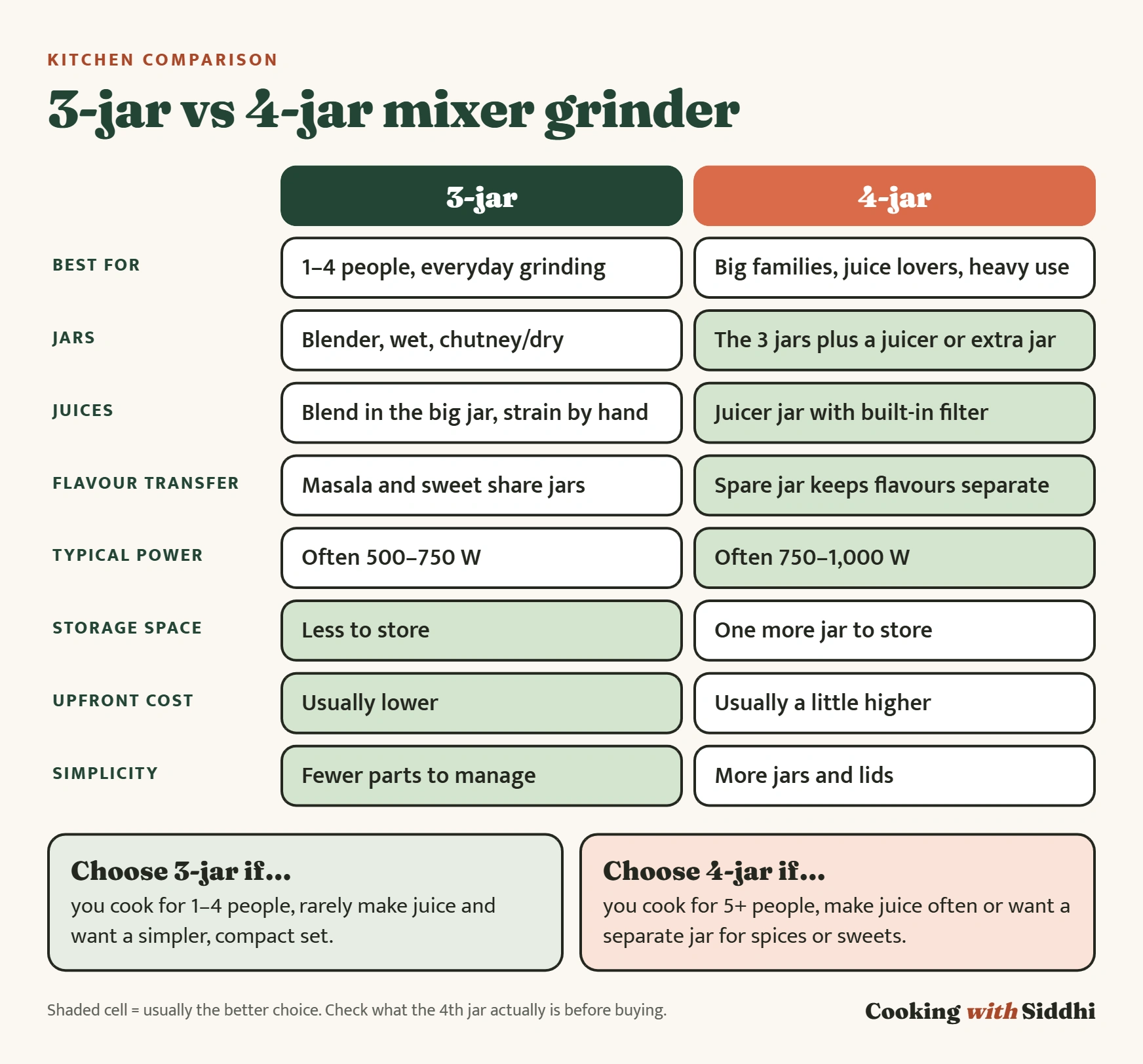
Side-by-side comparison
| Feature | 3-jar mixer grinder | 4-jar mixer grinder |
|---|---|---|
| Jars | Blender, wet, chutney or dry | Blender, wet, chutney or dry, plus a juicer or extra jar |
| Best household size | One to four people | Four or more people |
| Typical wattage | Often 500 to 750 W | Often 750 to 1,000 W |
| Juices | Blend and strain by hand | Juicer jar strains for you |
| Keeping flavours separate | Harder with shared jars | Easier with a spare jar |
| Storage | Less to store | One more jar and lid |
| Upfront cost | Usually lower | Usually slightly higher |
Does wattage matter more than the number of jars?
Often, yes. The motor does the hard work, so wattage affects how well the grinder handles tough jobs:
- 500 W: fine for light daily use, chutneys and soft masalas in a small household.
- 750 W: the sweet spot for most Indian kitchens, handling batter, masala and dry spices comfortably.
- 1,000 W and above: useful for heavy use, large families and hard spices like turmeric or dry coconut.
A 750 W 3-jar grinder will usually serve a family better than a weak 500 W 4-jar model. Look for overload protection, a sturdy base and good service support too. For batter in bigger quantities, read our wet grinder vs mixer grinder comparison.
Which should you buy?
- Students, couples and small families: a 3-jar, 500 to 750 W mixer grinder.
- Family of four that makes batter weekly: a 3-jar or 4-jar model of around 750 W.
- Large or joint families: a 4-jar model of 750 to 1,000 W, so jars don’t become a bottleneck at meal times.
- Juice every morning: a 4-jar set with a juicer jar, or a separate juicer if you want pulp-free juice.
- Lots of masala and sweets: a 4-jar set with a second dry jar to keep flavours apart.
Not sure you need a mixer grinder or something else entirely? Our mixer grinder vs food processor guide explains what each one is for.
Tips to get the most out of your jars
- Use the smallest jar that fits the quantity; small amounts grind better in small jars.
- Fill wet jars to about half or two-thirds, and add liquid gradually.
- Grind in short bursts and let the motor rest, especially for batter and hard spices.
- Wash jars soon after use, and dry them fully so the blades don’t rust or smell.
- Replace worn couplers and gaskets so jars don’t leak or slip.
Frequently asked questions
Is a 3-jar or 4-jar mixer grinder better?
A 3-jar mixer grinder is enough for most families of one to four people. A 4-jar model is better for large families, frequent juice making or if you want a separate jar to keep masala and sweet flavours apart.
What is the fourth jar in a mixer grinder used for?
It varies by brand. It’s usually a juicer jar with a built-in fruit filter, or an extra dry or chutney jar of a different size. Check the box contents before buying.
Which jar is used for idli batter?
The medium wet-grinding jar, usually about 1 to 1.2 litres, is meant for idli and dosa batter. Fill it to about half or two-thirds and grind in short bursts.
Which jar is best for chutney?
The small chutney or dry jar, usually about 0.3 to 0.5 litres, works best for green chutney, ginger-garlic paste and small amounts of masala.
What wattage mixer grinder is best for an Indian family?
Around 750 W suits most Indian families, handling batter, masala pastes and dry spices comfortably. Choose 1,000 W for heavy daily use or large families.
Can I make juice in a 3-jar mixer grinder?
Yes. Blend fruit in the large jar with a little water and strain it through a sieve. A 4-jar set with a juicer jar simply saves the straining step.
The bottom line
For most Indian kitchens, a good 3-jar, 750 W mixer grinder does everything you need. Go for 4 jars when your family is large, juice is a daily habit or you want a dedicated jar for spices, and always check what that fourth jar actually is before paying more for it.