
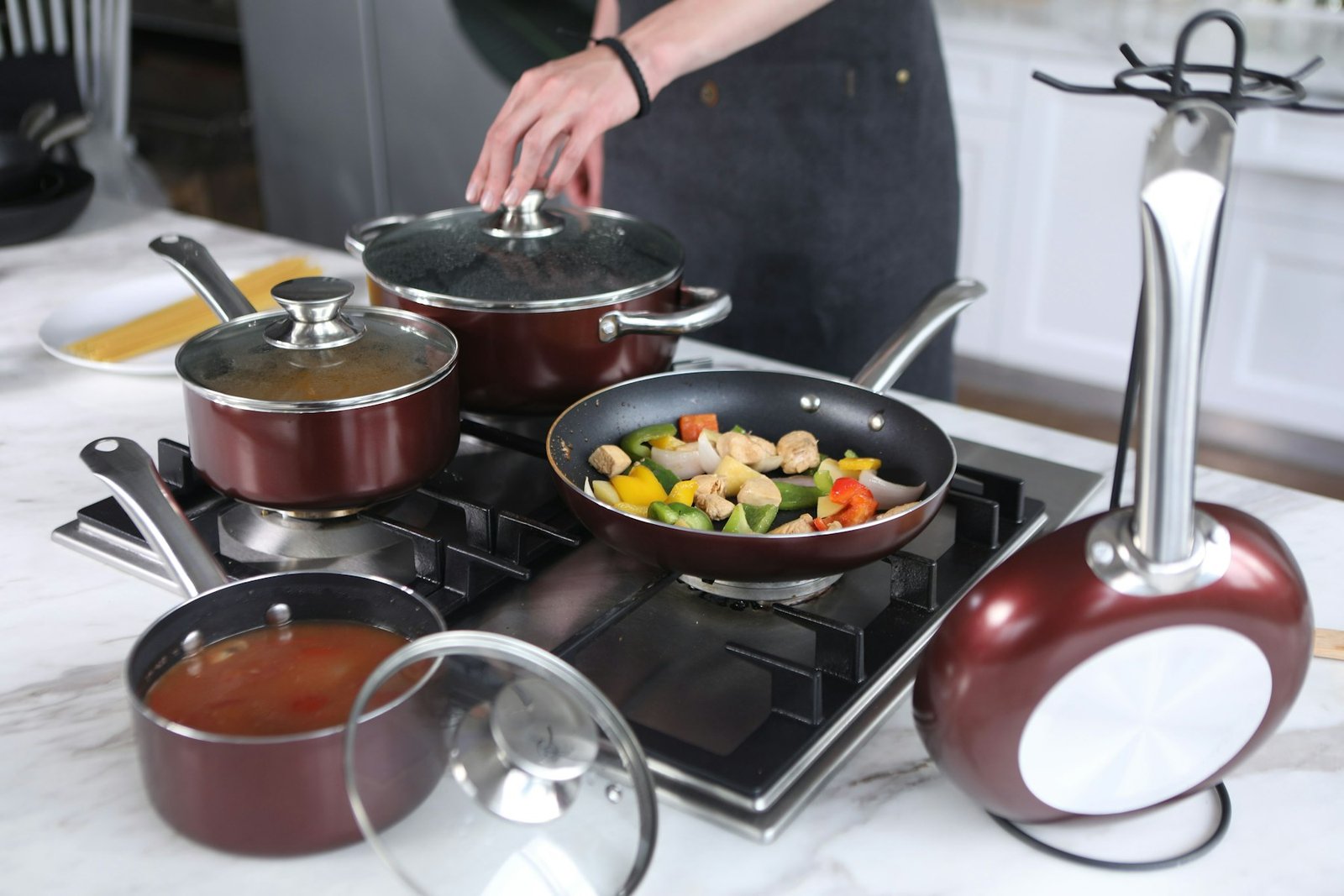
Thinking of switching from gas to induction, or adding an induction cooktop as a backup? You’re not alone. Many Indian families are weighing up induction for its speed and safety, while others can’t imagine making phulkas without a flame. So which really suits an Indian kitchen?
This guide compares an induction cooktop vs gas stove for everyday Indian cooking: rotis, tadka, pressure cooking and deep frying, plus running cost, safety, power cuts and the cookware you’ll need.
The short answer: induction or gas?
Choose induction if you want faster, safer, more efficient cooking and use flat-bottomed steel or cast iron cookware. Stay with gas if you make phulkas and roast on an open flame every day, use a mix of cookware, or face frequent power cuts. Many Indian homes do best with both.
- Induction: heats the pan directly, boils quickly, has no open flame and keeps the kitchen cooler.
- Gas: works with any vessel, gives a direct flame for rotis and papad, and doesn’t depend on electricity.
- Best of both: a gas stove for daily cooking plus a single induction cooktop for quick jobs and backup.
How do they work?
A gas stove burns LPG or piped natural gas (PNG) to make a flame that heats the vessel from below. A lot of that heat escapes around the sides of the pan into the kitchen.
An induction cooktop uses a magnetic field to heat the base of a compatible pan directly. The glass surface itself doesn’t produce heat; it only gets warm from the hot pan. Because the energy goes straight into the vessel, induction wastes far less heat.
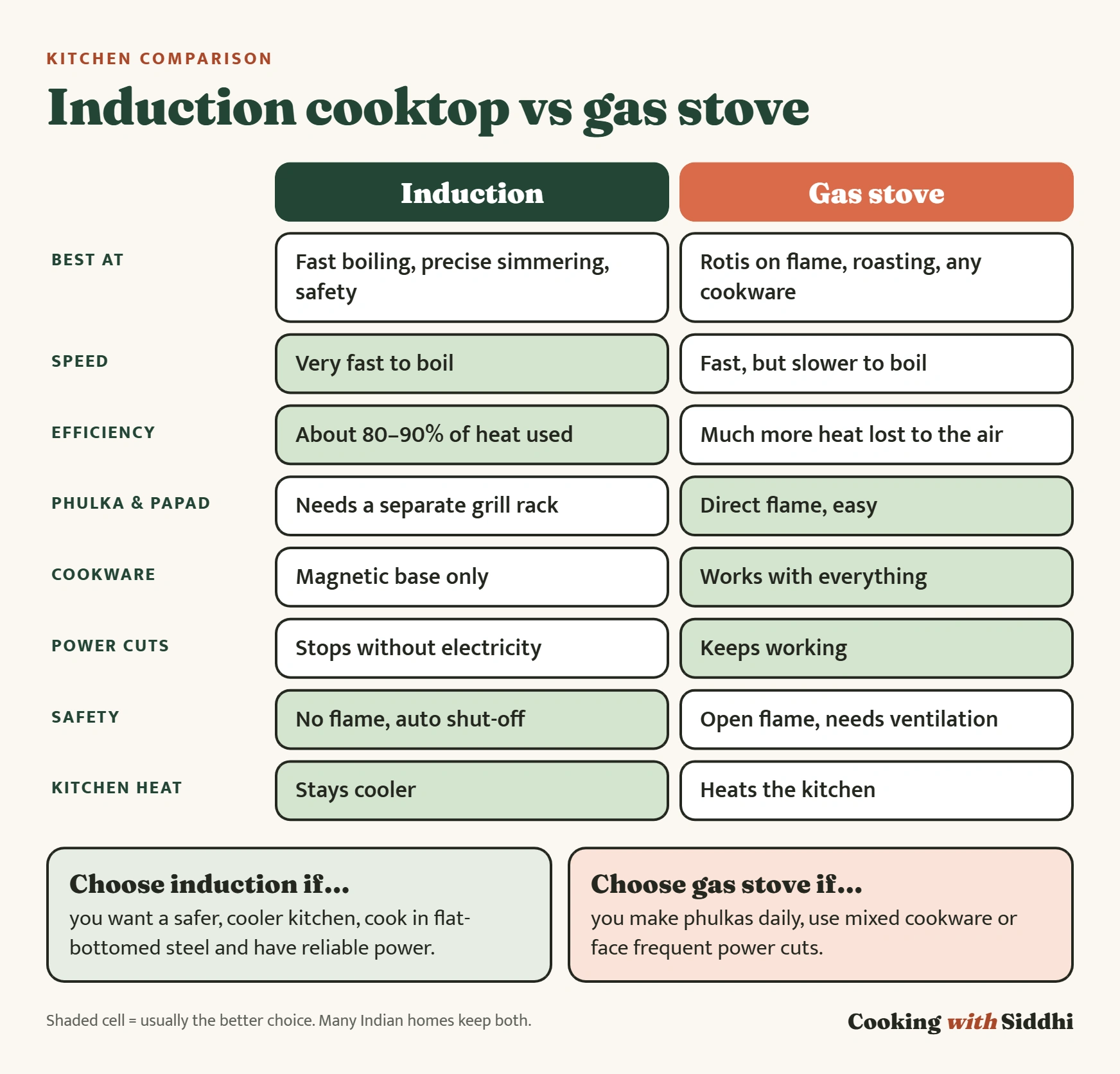
Side-by-side comparison
| Feature | Induction cooktop | Gas stove |
|---|---|---|
| How it heats | Magnetic field heats the pan directly | Flame heats the pan from below |
| Energy efficiency | Roughly 80 to 90% of energy reaches the food | A large share of heat is lost to the air |
| Speed | Very fast to boil water, milk and dal | Quick, but slower to boil |
| Temperature control | Precise steps and timers | Instant visual control of the flame |
| Cookware | Needs a magnetic (induction) base | Works with any vessel |
| Rotis and roasting | Needs a phulka grill or tawa | Direct flame for phulkas, papad, baingan |
| Power cuts | Doesn’t work without electricity | Unaffected |
| Safety | No open flame; auto shut-off on most models | Open flame; risk of gas leaks |
| Cleaning | Flat glass top wipes clean | Burners and pan supports need scrubbing |
| Kitchen heat | Stays much cooler | Heats up the kitchen |
Which is better for Indian cooking?
Rotis, phulkas and parathas
Winner: gas. Puffing phulkas directly on a flame is hard to beat. On induction, you can cook rotis on a flat tawa and puff them using a mesh phulka grill or by pressing gently with a cloth. Parathas cook perfectly well on an induction-compatible tawa.
Tadka and tempering
Tie. Both heat oil quickly. Induction’s instant power steps make it easy to drop the heat before adding hing and chilli powder. See our guide to the perfect tadka for timing.
Pressure cooking dal and rice
Winner: induction, if your cooker has an induction base. It comes to pressure quickly and many models have timers, so you can walk away. Old aluminium cookers without a steel base won’t work on induction.
Boiling milk and making chai
Winner: induction. It boils milk fast, and the lower settings help prevent boil-overs. Spills also wipe off the flat glass easily.
Deep frying and kadai cooking
Winner: gas for round-bottomed kadais. Induction needs a flat base touching the glass, so traditional round-bottomed kadais and woks don’t heat well. A flat-bottomed steel or cast iron kadai works fine on induction.
Roasting papad, baingan and corn
Winner: gas. Direct-flame roasting for baingan bharta, bhutta and papad needs a flame. On induction, use a grill pan, oven or air fryer instead.
Running cost: induction or gas?
It depends on two local prices: what you pay per unit of electricity and what you pay for an LPG cylinder or PNG. Induction converts far more of its energy into cooking heat, so it often uses less energy for the same job. Whether it costs less depends on your tariff.
- Estimate induction cost: power in kW × hours used × your tariff per unit. Boiling dal in a pressure cooker on a 2 kW cooktop for 15 minutes uses about 0.5 units.
- Compare with gas: track how long a cylinder lasts your family and divide its price by the number of days.
- Rule of thumb: induction tends to work out cheaper where electricity tariffs are low or you have rooftop solar, and gas can be cheaper where electricity is expensive.
Safety and practical considerations
- Socket and wiring: most induction cooktops draw up to about 2,000 W, so use a properly rated wall socket and avoid cheap extension boards.
- Power backup: if you have frequent outages, keep a gas burner or an inverter that can handle the load.
- Gas safety: check pipes and regulators regularly, keep the kitchen ventilated and turn the regulator off at night.
- Pacemakers: anyone with a pacemaker or similar medical implant should check with their doctor before using induction.
- Children: induction surfaces stay cooler than gas burners, but the glass still gets hot from the pan, so caution is needed.
Cookware: will your pots work on induction?
Induction only works with cookware that has a magnetic base. A quick test: if a fridge magnet sticks firmly to the bottom, it will work.
- Works: most stainless steel (especially tri-ply or with an induction base), cast iron, and enamelled iron.
- Doesn’t work: plain aluminium, copper, glass, clay and most round-bottomed kadais.
- Check pressure cookers: look for an induction base or buy a steel model. Our guide compares aluminium and stainless steel pressure cookers.
- Nonstick: only models labelled induction compatible. Read our stainless steel vs nonstick cookware comparison before buying new pans.
Who should choose which?
- Students, PG and bachelors: a single induction cooktop is safer and portable, with no cylinder to arrange.
- Families who make phulkas daily: keep gas as the main stove; add induction for boiling and pressure cooking.
- Homes with reliable power or solar: induction can handle most daily cooking.
- Frequent power cuts: stick with gas, with induction as a convenience extra.
- Elderly parents or young children at home: induction’s auto shut-off and lack of open flame add peace of mind.
Frequently asked questions
Is induction better than a gas stove?
Induction is faster, more energy-efficient, safer and keeps the kitchen cooler. Gas is better for cooking rotis and roasting on a flame, works with any cookware and doesn’t need electricity. The better choice depends on what you cook and how reliable your power supply is.
Can I make rotis on induction?
Yes. Cook rotis on an induction-compatible flat tawa, then puff them with a mesh phulka grill or by pressing gently with a cloth. Parathas cook perfectly well on an induction tawa.
Does induction use a lot of electricity?
Induction cooktops typically draw between about 1,200 and 2,100 W at high settings, but they cook quickly and waste little heat. A 15-minute job at 2 kW uses about half a unit of electricity.
Which utensils work on induction?
Utensils with a magnetic base, such as most stainless steel, cast iron and induction-base nonstick. Plain aluminium, copper, glass and clay don’t work. If a magnet sticks firmly to the base, it will work.
Is induction cooking safe?
Yes, for most people. There’s no open flame and most models switch off automatically. People with pacemakers should check with their doctor first.
Can I use a pressure cooker on induction?
Yes, if it has an induction-compatible base. Stainless steel cookers and aluminium cookers with an induction base both work.
The bottom line
Induction is the safer, faster and cleaner choice for boiling, simmering and pressure cooking, while gas still wins for phulkas, roasting and power-cut-proof cooking. If you can, keep both: gas for the flame jobs, induction for everything quick.